


Broker Fraud in Trucking: How Carriers and Dispatchers Can Verify Brokers in 2026
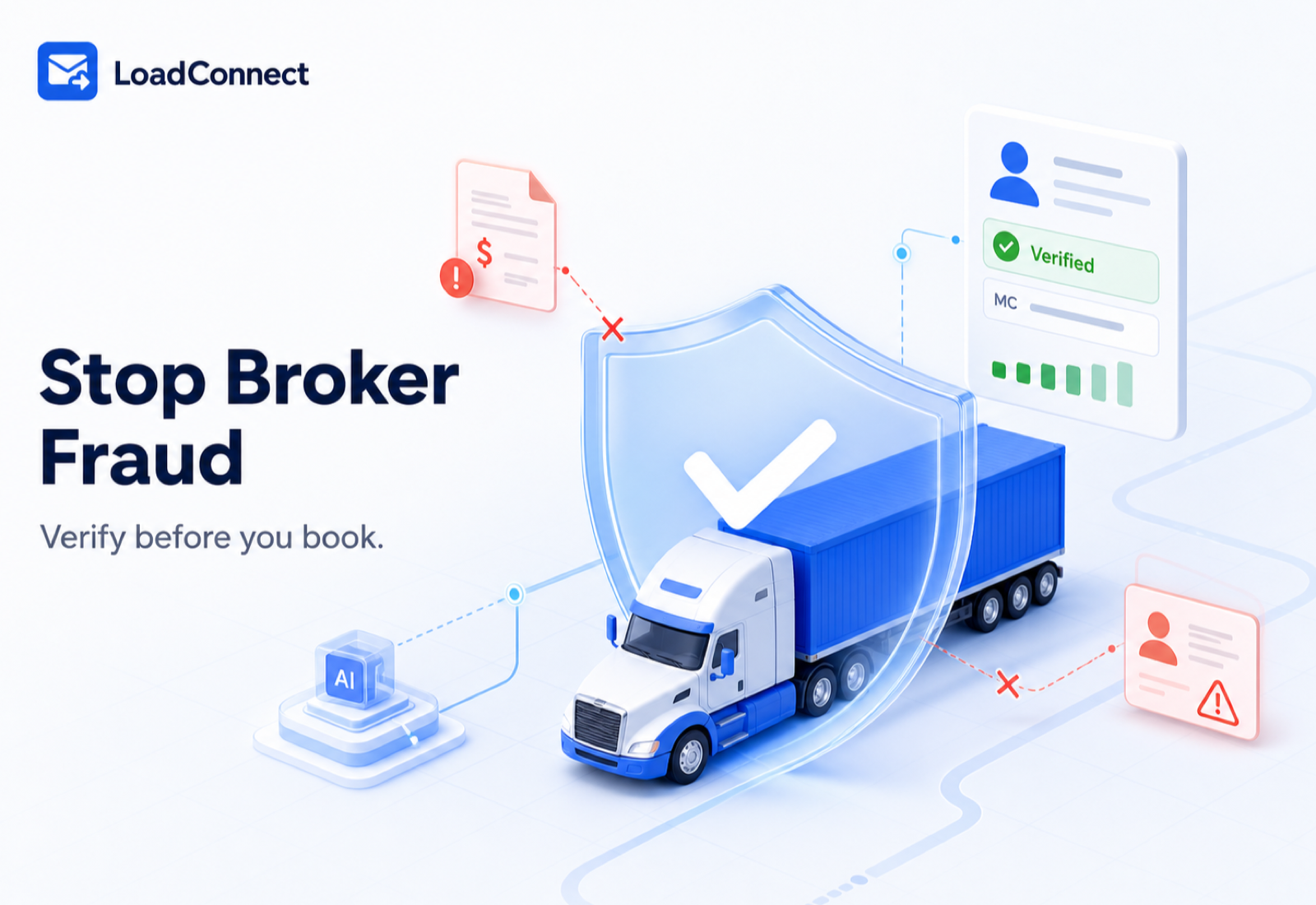
Quick answer: The biggest broker-related threats to carriers and dispatchers in 2026 include double brokering, broker impersonation, non-payment, rate confirmation fraud, phishing, and identity theft. The FBI reported that estimated cargo theft losses across the United States and Canada reached nearly $725 million in 2025, up 60% year over year. Verifying a broker’s authority, payment history, contact identity, and load documents before booking has become a critical part of freight risk management. LoadConnect brings key verification and risk signals directly into the dispatch workflow, helping teams evaluate a load before committing a truck.
Every dispatcher has seen it: the load looks right, the rate is solid, and the broker sounds legitimate — until the payment never arrives, the contact disappears, or the paperwork no longer matches the company that posted the freight.
Broker fraud is no longer limited to obviously fake companies. Modern schemes increasingly rely on real identities, compromised accounts, spoofed emails, and legitimate-looking documents. Fraudsters exploit the same speed that makes the spot market work: dispatchers often have only minutes to evaluate a load before someone else takes it.
This guide explains the main forms of broker fraud carriers and dispatchers face in 2026, how to verify a freight broker before booking, and how LoadConnect’s AI-assisted dispatch workflow helps bring verification into the freight decision itself.
Why Broker Fraud Is Getting Harder to Detect
Freight fraud has become increasingly digital and identity-driven.
In an April 2026 warning, the FBI described cyber-enabled strategic cargo theft schemes in which criminals impersonate legitimate brokers and carriers, compromise business accounts, publish fraudulent load-board listings, and redirect shipments. The agency reported that estimated cargo theft losses in the United States and Canada reached nearly $725 million in 2025, a 60% increase from 2024. The average value per confirmed theft also rose 36% to almost $274,000.
Double brokering has also remained a persistent industry problem. In a 2023 FreightWaves and TriumphPay survey of brokers, 3PLs, and asset-based carriers, 85% of respondents reported being affected by double brokering during Q2 2023.
The digital scale of fraud has increased as well. Highway reported blocking nearly 2 million fraudulent email attempts in 2025, along with more than 8.5 million fraudulent phone numbers across its network.
For dispatchers, the practical lesson is simple: confirming that an MC number exists is no longer enough. The identity, contact details, authority, payment history, and paperwork associated with the load also need to make sense together.
The Main Broker Fraud Risks Carriers and Dispatchers Face
Double Brokering
Double brokering generally occurs when freight that has already been assigned is re-brokered to another party without the required authorization or transparency.
The result can be a chain of parties in which the carrier actually hauling the load does not have a direct relationship with the original broker or shipper. This creates payment, liability, and insurance risks and can make it difficult to determine who is responsible when something goes wrong.
For carriers, one of the biggest warning signs is a mismatch between the company that posted the load, the company communicating with the dispatcher, and the company named on the rate confirmation.
Fraudulent and Impersonated Brokers
Some scammers operate without proper broker authority. Others impersonate legitimate brokerages.
They may use:
- a real company name;
- a legitimate MC number;
- lookalike email domains;
- spoofed phone numbers;
- copied rate confirmations;
- compromised brokerage accounts.
Because some of the information is real, a basic MC-number search can create a false sense of security.
The important question is not only “Does this brokerage exist?”
It is also “Am I actually communicating with that brokerage?”
Non-Payment and Slow-Pay Brokers
Not every payment problem is fraud. A brokerage can have active authority and still have poor payment practices, recurring disputes, or financial problems. That makes payment-risk information an important part of broker verification.
Before accepting a load, carriers and dispatchers should consider available information such as:
- payment history;
- factoring status;
- average days to pay;
- reported disputes;
- recent changes in payment behavior.
For carriers using factoring, this is also why understanding the difference between recourse and non-recourse factoring matters: the structure determines who ultimately bears the loss if a customer does not pay.
Rate Confirmation Fraud
Fraudulent rate confirmations can look almost identical to legitimate documents.
Common warning signs include:
- a company name that differs from the load posting;
- altered payment instructions;
- suspicious contact information;
- unexpected changes to pickup or delivery instructions;
- rates or terms that differ from what was agreed verbally.
A dispatcher working quickly may overlook a small mismatch that becomes obvious only after the load has moved.
Load Board Phishing and Fake Postings
Fake load postings can be used for more than stealing freight.
Some are designed to collect:
- carrier authority details;
- insurance certificates;
- driver information;
- banking data;
- onboarding documents;
- login credentials.
Fraudsters may also use spoofed emails, fake URLs, and compromised transportation-industry accounts to make these schemes look legitimate.
That means even a familiar-looking load-board account or email thread should not automatically be treated as proof of identity.
Identity Theft and MC Number Misuse
Fraudsters may also impersonate carriers. A legitimate carrier’s MC or DOT information can be used to book freight, submit documents, or communicate with brokers without the real company knowing.
This creates risk on both sides of the transaction:
- carriers can have their identity misused;
- brokers can unknowingly assign freight to an impersonator;
- shippers can lose control of cargo;
- legitimate companies can suffer reputational damage.
Identity verification is therefore becoming just as important as authority verification.
How to Verify a Freight Broker Before Booking a Load
A consistent verification process can prevent many of these problems. Before accepting a load, dispatchers should review several signals together rather than relying on one database entry.
1. Check broker authority
Confirm that the broker’s MC and USDOT information is consistent with the company you believe you are working with.
Review:
- legal company name;
- operating authority;
- company address;
- registration information.
2. Verify the contact independently
Do not rely only on the phone number or email included in the load posting. If anything looks unusual, verify the contact through an independent source already associated with the brokerage.
Pay attention to:
- lookalike email domains;
- recently changed contact details;
- personal email addresses;
- phone numbers that do not match known company information.
3. Review payment and factoring information
Authority answers one question: “Can this company legally broker freight?”
It does not necessarily answer: “Will this company pay reliably?”
Review available payment-risk and factoring data where possible.
4. Compare the rate confirmation with the load
Check whether the following are consistent:
- company name;
- MC number;
- origin and destination;
- agreed rate;
- pickup instructions;
- contact information.
Any unexplained mismatch deserves additional verification.
5. Watch for behavioral red flags
Suspicious behavior can include:
- unusual urgency;
- pressure to skip standard onboarding;
- rates far above normal market expectations;
- last-minute routing changes;
- requests for sensitive documents before identity has been confirmed;
- repeated changes in phone numbers or email addresses.
No single signal necessarily proves fraud. The risk increases when several inconsistencies appear together.
Broker Verification vs Carrier Verification
Broker verification and carrier verification address the same trust problem from opposite sides of a freight transaction.
Broker verification helps carriers and dispatchers evaluate the brokerage offering a load, including authority, identity, payment information, and fraud signals.
Carrier verification works in the opposite direction: freight brokers evaluate the carrier that may haul the load, including authority, insurance, safety information, company identity, and risk signals.
For freight brokers, LoadConnect provides dedicated Carrier Verification Software for this workflow.
In both cases, the principle is the same: verify the party before committing the load.
Why Manual Broker Verification Breaks Down Under Time Pressure
The problem is not usually a lack of information. It is fragmentation.
A dispatcher may need to check:
- FMCSA records;
- broker authority;
- factoring information;
- payment history;
- emails;
- rate confirmations;
- load-board information;
- internal notes.
Each source provides only one part of the decision. When dispatchers are reviewing dozens of opportunities per day, repeating that process manually creates two problems:
Time loss. Every additional lookup slows the booking process.
Inconsistent verification. Under time pressure, some checks get skipped or performed differently from one dispatcher to another.
This is where workflow-level verification becomes more useful than another standalone database.
How LoadConnect’s AI Dispatch Assistant Helps Reduce Broker Fraud Risk
LoadConnect is designed to bring relevant freight information into the workflow where dispatchers are already making booking decisions.
Instead of treating broker verification as a separate research task, it surfaces relevant context around the opportunity itself.
The goal is not to automatically decide whether a broker is trustworthy. It is to give the dispatcher better information before making the decision.
Broker Safety and Identity Context
LoadConnect brings broker-related FMCSA and company information into the load workflow so dispatchers can review important signals before engaging with the opportunity. That reduces the need to repeatedly leave the load board and perform separate searches.
Factoring and Payment-Risk Information
Through LoadConnect’s integration with OTR Solutions, dispatchers can access available factoring and broker-payment information as part of their workflow.
A broker may have valid operating authority but still present payment risk. Looking at both regulatory and payment information gives the dispatcher more context than authority status alone.
Scam Email Alerts
LoadConnect helps identify suspicious email activity across freight workflows. This matters because modern freight fraud often relies on compromised or impersonated accounts rather than completely fabricated companies.
Rate Confirmation Summarizer
LoadConnect can summarize rate confirmations directly inside Gmail. This makes key information easier to review and can help dispatchers notice inconsistencies in company names, routes, rates, and other load details without manually scanning every document from scratch.
Verification Inside the Workflow
The broader advantage is not any single verification signal. It is having multiple pieces of freight context available closer to the moment when the booking decision is made.
That is part of LoadConnect’s wider approach to AI Dispatch Software: using automation and AI-assisted analysis to reduce fragmented manual work while keeping the dispatcher responsible for the final decision.
AI-Assisted Verification Supports the Dispatcher’s Decision
AI can surface mismatched information, authority data, payment-risk signals, and suspicious communications, but those signals still require context.
LoadConnect acts as a decision-support layer: it organizes relevant information while the dispatcher remains responsible for the final booking decision.
The workflow becomes:
Find a load
↓
Evaluate rate and route
↓
Verify broker information
↓
Review payment and fraud signals
↓
Review load documents
↓
Make the booking decision
Broker verification is therefore not an isolated feature. It is one part of a broader freight decision process.
What Broker Verification Looks Like by Role
For Owner-Operators and Small Carriers
The priority is protecting a limited number of trucks from a bad transaction. A single unpaid load or fraudulent booking can have a disproportionate impact on cash flow. Verification helps the carrier evaluate the broker before committing equipment and driver time.
For Dispatchers
Dispatchers need speed and consistency. A repeatable verification workflow reduces reliance on memory and makes it easier to apply the same checks across different brokers and load boards.
For Fleets
Larger fleets have another challenge: scale. Multiple dispatchers may be booking freight with hundreds of brokers.
Centralizing verification signals can help teams identify repeated risk patterns and reduce inconsistent decision-making across the operation.
Practical Broker Verification Checklist
Before booking a load:
- Confirm that the broker’s MC information and legal company name match.
- Review operating authority.
- Check available payment and factoring information.
- Verify suspicious contact details through an independent source.
- Confirm that the company on the rate confirmation matches the party offering the load.
- Review origin, destination, rate, and instructions for inconsistencies.
- Be cautious when a rate appears unusually high without a clear reason.
- Treat unexpected routing or payment changes as a reason to re-verify the contact.
- Do not send sensitive carrier or banking information before confirming the requester’s identity.
- Keep copies of rate confirmations and important communications.
- Investigate multiple warning signs together rather than relying on one risk indicator.
The goal is not to make every booking slower. It is to make verification repeatable enough that critical checks do not disappear when the dispatcher is under pressure.
FAQ
How Do I Verify a Freight Broker Before Booking a Load?
Check the broker’s authority and company information, verify that the contact details match the legitimate brokerage, review available payment or factoring information, and compare the rate confirmation with the load that was originally offered. If several details do not match, verify them independently before accepting the load.
How Can I Check Whether a Broker’s MC Number Is Legitimate?
Confirm the MC number against official FMCSA information and make sure the legal business name associated with the authority matches the company communicating with you. A legitimate MC number alone does not prove that the person contacting you actually represents that brokerage.
What Are Common Signs of Freight Broker Fraud?
Common warning signs include mismatched company names, lookalike email domains, unusual payment instructions, pressure to act immediately, suspiciously high rates, unexpected routing changes, and contact information that cannot be independently verified.
What Is Double Brokering?
Double brokering generally occurs when freight is re-brokered or reassigned without the required authorization or transparency. It can create payment, liability, and insurance problems because the carrier hauling the load may not have a direct relationship with the original party that arranged the freight.
Does LoadConnect Help Identify Broker Fraud?
LoadConnect brings broker, FMCSA, payment, and workflow information closer to the booking decision and can surface signals that deserve additional review. It supports the dispatcher’s verification process but does not guarantee that a broker or transaction is risk-free.
Verify Before You Book or Commit a Truck
Broker fraud increasingly depends on speed, fragmented information, and identity confusion. The most effective response is not simply adding another manual lookup. It is building verification into the freight decision itself.
LoadConnect brings broker information, payment context, fraud signals, and load documentation into an AI-assisted dispatch workflow so dispatchers can review the information that matters before committing equipment.
The final decision remains with the dispatcher — but the information needed to make that decision no longer has to be scattered across multiple systems.
Bring broker verification, payment context, FMCSA data, and fraud signals into one dispatch workflow.