


The Biggest Risk of AI Dispatch Software Isn't Automation - It's Access
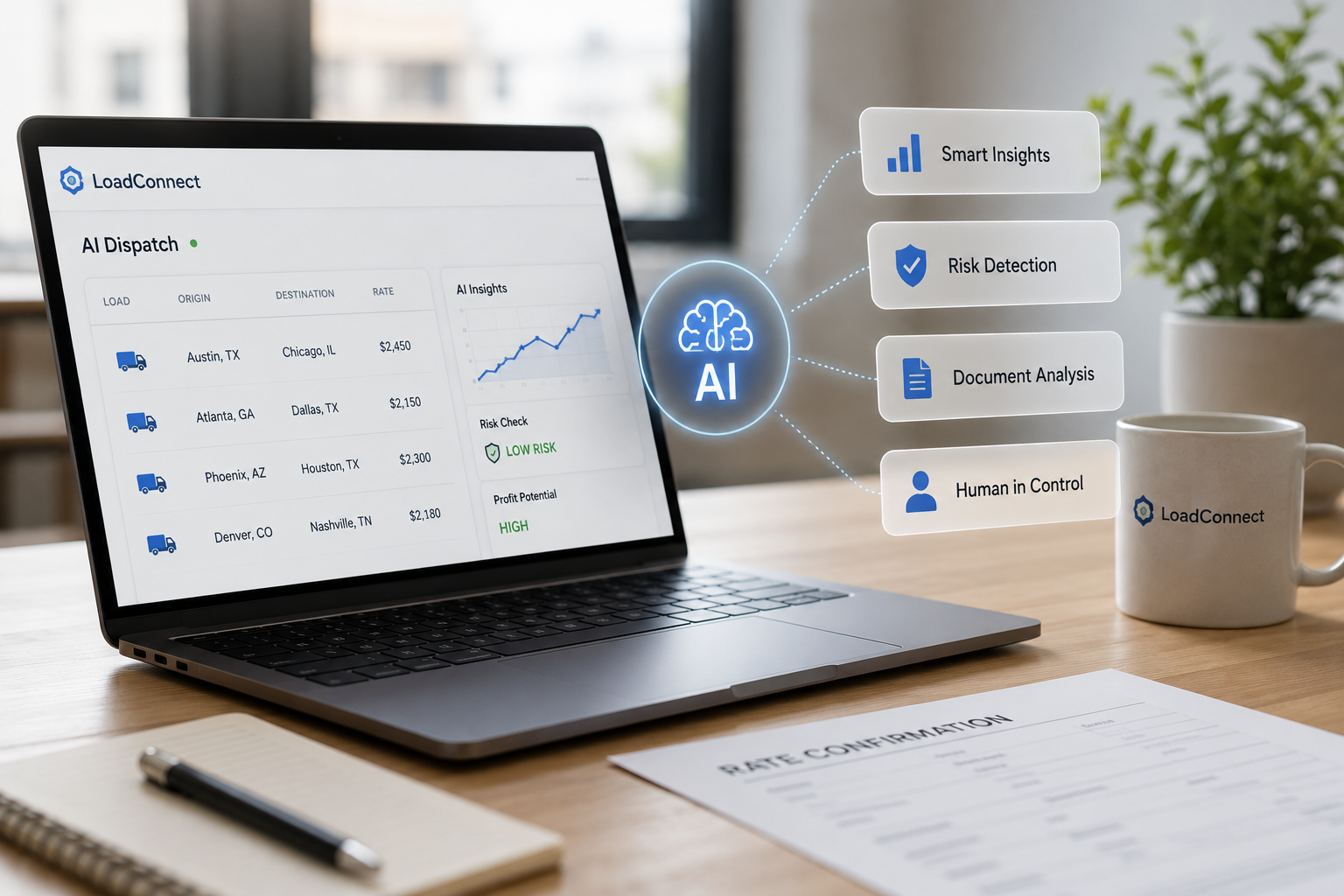
Every few weeks, a new AI company announces another breakthrough. AI agents can now book loads, communicate with brokers, analyze freight opportunities, and perform tasks that recently required human involvement.
As a result, the conversation around artificial intelligence in trucking has evolved. A few years ago, most discussions focused on efficiency and automation. Today, carriers are asking a different question: how much access should AI actually have?
Can AI dispatch software help dispatch teams work faster, reduce manual work, and improve decision-making? Absolutely. But as these systems become more capable, the real challenge is no longer what AI can do - it's what AI can access.
Shipment data, customer information, operational workflows, financial records, internal communications, and browser sessions all represent potential entry points for modern AI tools. The more connected a system becomes, the more important security, permission boundaries, and human oversight become.
This is why the future of trucking will not be defined solely by better automation. It will be defined by trust. As carriers evaluate the next generation of AI-powered tools, they are increasingly focused not only on capabilities, but also on control.
Because in freight operations, an AI system with excessive access can create as much risk as it creates value.
What Is an AI Dispatcher?
The term AI dispatcher has become one of the most talked-about concepts in logistics, but it is often misunderstood.
Many people imagine an AI dispatcher as a fully autonomous system capable of replacing human dispatchers and managing freight operations on its own. In reality, most modern AI tools function more as operational assistants than autonomous operators.
An AI dispatcher uses artificial intelligence to analyze information, identify patterns, automate repetitive tasks, and help dispatch teams make faster, more informed decisions. Rather than replacing people, these systems are designed to reduce manual workload and improve visibility across daily operations.
Depending on the platform, an AI-powered dispatch solution may help teams:
- Review shipment documents
- Detect discrepancies in Rate Confirmations and Bills of Lading
- Analyze carrier and broker information
- Flag potential fraud risks
- Organize operational data
- Support dispatch decision-making
This is why terms such as dispatch AI and AI dispatch software are becoming increasingly common throughout the trucking industry. Unlike traditional software that simply stores information and waits for user input, AI-powered systems can actively analyze data, identify issues, and surface insights that might otherwise go unnoticed.
For dispatch teams managing dozens or hundreds of loads each week, that capability can create a significant operational advantage. But it also introduces an important question that many carriers are only beginning to ask:
If AI can review documents, analyze freight data, and support operational decisions, how much access should it actually have?
The Hidden Risk of AI Agents
As AI systems become more capable, most discussions focus on what they can do. Whether they can analyze documents, automate workflows, detect fraud, or improve dispatch efficiency are all valid questions. But they are not the most important ones.
For many trucking companies, the real concern is not automation - it is control. The risk is rarely the technology itself, but what an AI system can access and what it is allowed to do once that access is granted. As AI agents become more deeply integrated into daily operations, understanding those boundaries becomes just as important as evaluating their capabilities.
Too Much Access
Every AI system depends on data, but problems begin when access extends beyond what is necessary for the task.
A document verification tool should not need access to financial systems. A dispatch assistant should not require visibility into every credential, communication channel, or internal workflow. Yet many modern AI products are expanding permissions because broader access enables broader automation.
This creates a fundamental tradeoff. More access often increases usefulness, but it also increases exposure. For carriers evaluating new AI tools, the key question is not just what the system can do, but why it needs access to specific parts of the business in the first place.
The problem is not that AI requires data. Every intelligent system depends on information to perform useful work.
The real question is how much information is actually necessary.
A document verification tool should only access the documents it needs to analyze. A dispatch assistant should only access the operational data required to support decision-making. Anything beyond that increases exposure without necessarily increasing value.
This concept is often referred to as the principle of minimum necessary access: systems should only receive the permissions required to perform a specific task - nothing more.
As AI capabilities expand, this principle becomes increasingly important. The safest AI systems are not those with the most access. They are the systems designed to operate effectively with the least amount of access possible.
Too Much Autonomy
Access becomes significantly more sensitive when combined with autonomy.
There is a clear difference between an AI assistant that identifies a discrepancy and an AI agent that independently modifies records, sends communications, updates shipment information, or executes operational actions without approval. Both rely on artificial intelligence, but the risk profile is fundamentally different.
In freight operations, even minor errors can cascade into major disruptions. A wrong appointment update can cause delays, a missed instruction can affect service levels, and an incorrect action can impact customers, drivers, and revenue. This is why more organizations are cautious about fully autonomous systems. The question is not whether AI can make decisions, but whether every decision should be delegated to it.
Data Leakage Risks
Data security has become a central concern in AI adoption.
Carriers, brokers, and logistics providers handle highly sensitive information, including shipment details, pricing data, contracts, customer records, and internal communications. Before adopting any AI platform, companies need clear answers to key questions: what data is collected, where it is stored, who can access it, how long it is retained, and whether it can be used beyond the original purpose.
As AI platforms expand and integrate deeper into business systems, trust is no longer based on documentation or promises alone. It is based on what a system is technically capable of accessing - and whether that aligns with its actual function.
Browser Extension Risks
Not all browser extensions operate the same way. The level of access depends entirely on how the extension is designed and which permissions it requires.
Browser-based AI tools introduce a different layer of risk because their permissions are often misunderstood.
Many users assume extensions only interact with the page currently in view. In reality, browser permissions can extend to cookies, active sessions, browsing activity, website content, and even data across multiple domains, depending on the design.
This does not make browser extensions inherently unsafe, but it does make transparency essential. Organizations need to clearly understand what access is being granted and whether it is justified by the value the tool provides. This becomes especially important in high-trust operational environments like freight dispatching.
Ultimately, AI adoption will not be defined by capability alone. It will be defined by trust - and trust depends on knowing exactly where access begins, where it ends, and who remains in control of critical decisions.
Why The Future Is AI Copilots, Not AI Autopilots
The idea of fully autonomous AI systems has been promoted for years, but in real-world operations the direction is becoming much clearer.
The most effective systems are not replacing people - they are amplifying them. This is why trucking AI is increasingly shifting toward copilots rather than autopilots.
A copilot model allows AI to handle high-volume analysis, document processing, and repetitive verification tasks while keeping humans responsible for approvals, decisions, and accountability. Instead of removing oversight, it reinforces it.
| Function | AI | Human |
|---|---|---|
| Detect discrepancies | ✅ | |
| Analyze documents | ✅ | |
| Recommend actions | ✅ | |
| Approve actions | ✅ | |
| Manage customer relationships | ✅ | |
| Final responsibility | ✅ |
This division reflects the natural strengths of both sides. AI processes large volumes of information quickly and consistently. Humans interpret context, manage relationships, and make decisions that depend on business priorities rather than data alone.
In freight operations, decisions are rarely purely technical. Customer expectations, broker behavior, service commitments, and operational constraints all influence the outcome. That complexity is exactly where human judgment remains essential.
The companies that benefit most from AI will not be the ones that remove humans from workflows. They will be the ones that use AI to eliminate repetitive work while preserving oversight where it matters most.
In other words, the future of trucking is not autonomous dispatch. It is intelligent assistance operating within clearly defined boundaries.
Questions Every Carrier Should Ask Before Adopting AI
As AI adoption accelerates in trucking, most vendors lead with capabilities - automation, speed, visibility, efficiency. But those are not the questions that determine whether a system is safe to deploy inside real dispatch operations.
The real evaluation starts earlier: what the system can access, and what it is allowed to do with that access.
Before looking at features, carriers should focus on control, permissions, and accountability.
What Data Can the AI Access?
Every AI system needs data to function, but not every system needs the same level of access.
Some tools operate strictly on user-provided documents. Others request broader visibility into operational workflows, communications, customer records, and internal systems.
The key question is simple: does the tool actually need this level of access to perform its job?
In many cases, the safest AI dispatch software is not the one that sees everything - but the one that works effectively with only what is necessary.
Does It Require Access to Cookies, Sessions, or Browser Activity?
Browser-based AI tools often rely on permissions that are easy to overlook but highly sensitive.
Depending on the architecture, an extension may access cookies, active sessions, browsing behavior, or cross-site data.
This does not automatically mean the tool is unsafe, but it does mean one thing clearly: permissions must be understood, not assumed.
Can It Take Actions Without Approval?
This is where automation becomes autonomy - and where risk increases sharply. Some dispatch AI tools only analyze and recommend. Others can modify data, send messages, or trigger workflows automatically.
In trucking operations, even small uncontrolled actions can cascade into real cost - missed appointments, incorrect updates, or broken communication chains.
That’s why the critical boundary is not analysis. It is approval.
Where Is Data Stored?
Access is only part of the equation. Data handling after processing is just as important. Carriers should understand where information is stored, how long it is retained, and who can potentially access it.
This becomes especially important when working with shipment data, pricing, contracts, and customer records - the core of any freight dispatch software workflow.
What Permissions Can Be Revoked?
A responsible system is not just one that grants access - it is one that allows control over that access.
Carriers should always be able to adjust, limit, or revoke permissions as operational needs change. If permissions are locked or unclear, governance becomes impossible - and trust becomes assumption, not control.
Who Remains Responsible for Decisions?
This is the final and most important question. When something goes wrong - a missed load, a wrong update, a delayed shipment - responsibility must still be clearly human.
The best ai dispatch software does not replace accountability. It supports it.
AI can process information. Humans remain responsible for outcomes.
Why This Matters
These questions are not theoretical. They determine whether AI becomes a productivity tool or an operational risk inside a trucking company.
The difference between safe AI and risky AI is not intelligence - it is control.
For carriers, the challenge is finding AI that delivers meaningful productivity gains without requiring unrestricted access to business systems and sensitive data.
This raises an important question: Can companies benefit from AI while maintaining strict control over permissions, data exposure, and decision-making?
Many vendors approach security as a policy issue. Users are asked to trust that permissions are managed correctly, safeguards are enforced consistently, and sensitive information is handled appropriately.
But there is another approach. Instead of controlling access after it has been granted, systems can be designed to avoid unnecessary access from the start.
In other words, security is not just a policy. It is an architectural decision.
How LoadConnect Uses AI Without Compromising Security
While many AI tools today are moving toward deeper integrations, broader permissions, and increasing autonomy, LoadConnect was built on a fundamentally different principle. AI should only access the information required to complete a specific task, and nothing beyond that. The goal is not to replace dispatch teams or create a fully autonomous system, but to provide meaningful intelligence while keeping control firmly in human hands.
Security by Design, Not by Promise
Most software vendors describe security through policies, certifications, or internal procedures. LoadConnect approaches it differently. Security is not treated as something you declare - it is something you design into the system itself.
Instead of relying on trust after the fact, the platform is intentionally built to limit what it can access from the beginning. That design choice reduces exposure, removes unnecessary risk, and gives carriers more confidence when introducing AI into their dispatch workflows.
In trucking, where teams constantly handle shipment data, customer records, pricing, and operational communication, the ability to limit access is often more valuable than adding new features.
What Makes LoadConnect's AI Approach Different
Most AI platforms are built around a simple assumption: the more access they have, the more value they can deliver. That leads to more integrations, more permissions, and deeper visibility into business systems.
LoadConnect was designed around the opposite idea. The safest AI is not the one that sees everything, but the one that only sees what is necessary to perform its function.
That principle defines the entire architecture. Unlike many AI dispatch software solutions, LoadConnect does not require access to passwords, browser cookies, active sessions, network traffic, financial systems, or unrestricted operational environments. Instead, it operates within tightly defined boundaries that significantly reduce risk while preserving functionality.
For carriers evaluating AI dispatch software, this creates a practical advantage. The system can still analyze documents, detect discrepancies, and support freight verification, without becoming deeply embedded into core business infrastructure.
As concerns around AI agents, data leakage, and over-permissioned tools continue to grow, security is no longer a secondary consideration. It is a deciding factor. And this is where LoadConnect clearly separates itself from most tools on the market.
How LoadConnect Approaches Access
LoadConnect is built around strict permission boundaries that define exactly what the system can and cannot access.
| Security Area | Why It Matters | LoadConnect |
|---|---|---|
| Password Access | Eliminating password access reduces the risk associated with credential exposure | ❌ |
| Cookie Access | Prevents AI systems from relying on authenticated sessions | ❌ |
| Background Monitoring | Ensures data is not collected outside active user workflows | ❌ |
| Network Traffic Inspection | Limits visibility into broader business operations and communications | ❌ |
| Cross-Site Visibility | Restricts access to only the information relevant to the task at hand | ❌ |
| Centralized Operational Data Storage | Reduces dependence on large repositories of sensitive business data | ❌ |
| User-Initiated Actions Only | Keeps users in control of when and how AI is used | ✅ |
| Isolated User Environment | Maintains strict boundaries around accessible information | ✅ |
Unlike systems that continuously collect or monitor data in the background, LoadConnect only operates when a user explicitly chooses to analyze shipment documents or operational information. This keeps the workflow simple, predictable, and significantly reduces unnecessary exposure.
Built Around Permission Boundaries
At its core, LoadConnect is not designed to observe everything happening across a business. It is designed to act only when it is needed.
The platform performs specific tasks such as document verification, freight analysis, dispatch support, and discrepancy detection, without requiring access to unrelated systems or sensitive internal infrastructure.
Users decide what gets analyzed and when. That difference matters more than it might seem at first glance.
Instead of creating an AI system that passively watches operations, LoadConnect creates an AI system that responds only when it is asked to. The result is a higher level of transparency, stronger operational control, and a much smaller security footprint.
Human-Controlled AI
LoadConnect follows the AI copilot model discussed earlier in the article. It can analyze information, identify discrepancies, highlight risks, and surface operational insights, but it does not operate independently of the user.
It does not make business decisions. It does not replace dispatcher judgment. It does not execute actions without human involvement.
Everything remains visible, explainable, and controlled. Every recommendation is reviewed by the user, and every decision stays with the team responsible for the operation.
For companies adopting trucking AI, this balance is becoming increasingly important. The goal is not to remove humans from the workflow, but to eliminate repetitive manual work so they can focus on judgment, coordination, and execution.
The Future of AI in Freight Must Be Trusted
The transportation industry does not need AI systems with unlimited access. It needs AI that solves real operational problems without crossing security boundaries that carriers cannot afford to lose control over.
As AI in trucking continues to evolve, trust is becoming a defining factor in adoption. Companies are no longer evaluating tools only by what they can do, but by what they are intentionally designed not to do.
That distinction is becoming critical. Because in freight operations, capability without control is not progress - it is risk. This is the philosophy behind LoadConnect.
It is built to help dispatch teams move faster, reduce manual workload, and improve decision-making - without requiring unrestricted access to sensitive operational systems, credentials, or internal workflows.
Instead of maximizing access to increase functionality, LoadConnect minimizes access to reduce exposure. It delivers intelligence where it matters, while keeping control where it belongs: with the people running the operation.
Because the future of freight AI will not be defined by unrestricted automation.
It will be defined by systems that are powerful enough to help - and controlled enough to be trusted.